


Most financial advice on the internet assumes you are earning decent money. “Just invest.” “Skip the lattes.” “Max out your 401(k).” That advice is written for people earning $80,000 a year. It is not written for you.
If you earn less than $3,000 a month, you already know the truth: every dollar matters, and saving feels impossible when bills eat your entire paycheck. But here is the thing most people never hear — saving your first $10,000 has nothing to do with how much you earn. It has everything to do with how you manage what you already have.
This guide is not theory. It is a step-by-step blueprint designed specifically for people earning under $3,000 per month. Follow these six steps exactly, and you will hit your first $10,000 milestone faster than you think.
Step 1: Know Your Real Numbers
You cannot save money if you do not know where it goes. This is not optional — this is the foundation of everything.
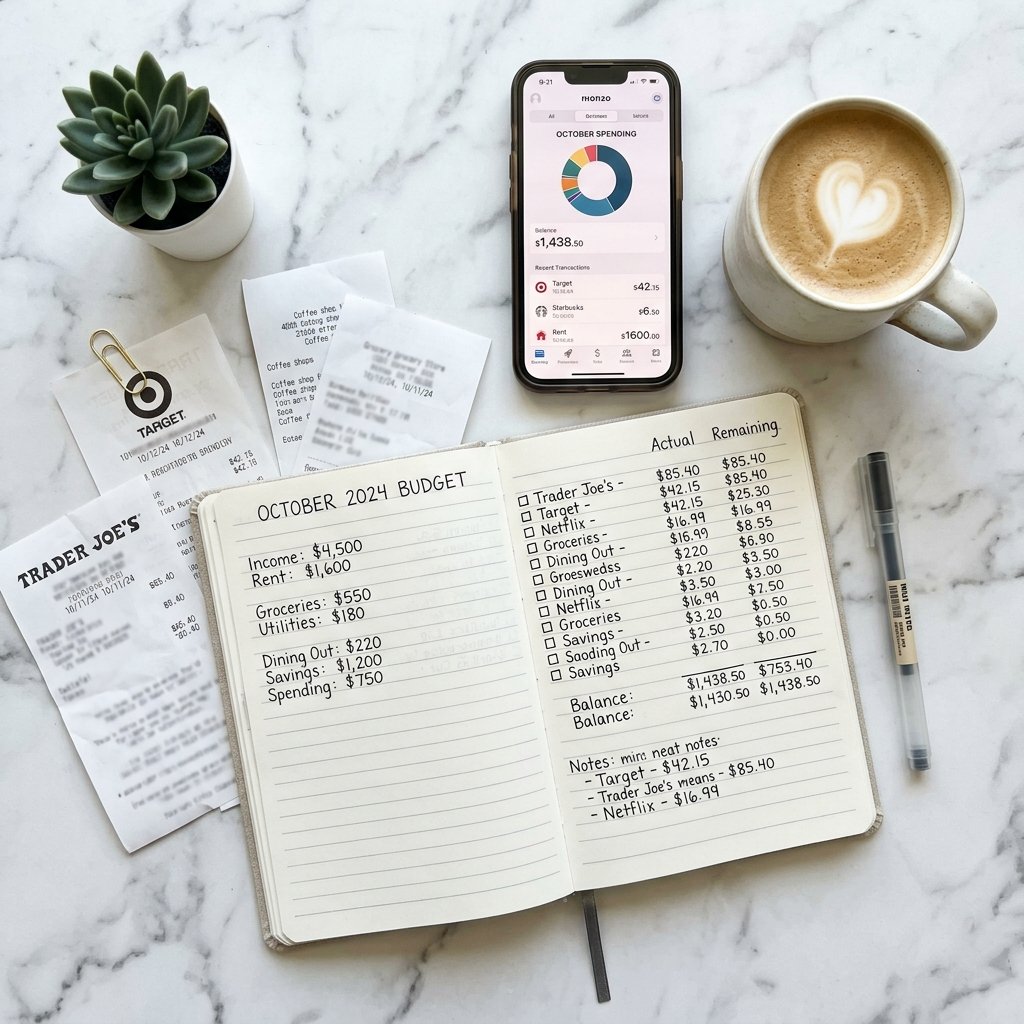
For the next 30 days, track every single dollar you spend. Use a free app like Mint, YNAB (free trial), or even a simple spreadsheet. Write down everything:
- Rent or mortgage payment
- Utilities (electric, water, internet, phone)
- Groceries and eating out
- Transportation (gas, insurance, bus pass)
- Subscriptions (Netflix, Spotify, gym)
- Random purchases (coffee, snacks, impulse buys)
After 30 days, you will see exactly where your money disappears. Most people discover they waste $200-$400 per month on things they do not even enjoy. That is your savings fund hiding in plain sight.
Action step: Open your banking app right now. Look at last month’s transactions. Write down your total income and total spending. The gap between those numbers is your starting point.
Step 2: Cut the Big Three Expenses
Forget clipping coupons. Small savings on groceries will not change your life. The three expenses that actually move the needle are housing, food, and transportation. These typically eat 60-75% of a low-income earner’s paycheck.
Housing (Target: Save $200-$600/month)
- Get a roommate — splitting rent can save $400-$600 monthly
- Negotiate your lease — ask for a $50-$100 reduction for a longer commitment
- Downsize to a smaller unit or move to a cheaper neighborhood
- If you have a spare room, sublet it on a month-to-month basis
Food (Target: Save $150-$300/month)
- Stop eating out entirely — $12 lunch × 5 days = $240/month = $2,880/year wasted
- Meal prep every Sunday — rice, beans, chicken, and frozen vegetables cost under $30/week
- Buy generic brands — they are literally the same product with a different label
- Use cashback apps like Ibotta for groceries you already buy
Transportation (Target: Save $100-$400/month)
- Sell a car with a payment — eliminate $350-$500/month instantly
- Use public transit, carpool, or bike when possible
- If you must drive, shop around for cheaper car insurance every 6 months
Combined, these three cuts alone can free up $400-$1,300 per month. That is $4,800-$15,600 per year. You can hit $10,000 in savings within 8-24 months just from these changes.
Step 3: Automate Your Savings (The “Pay Yourself First” Rule)
Here is the secret that separates people who save from people who don’t: automation removes willpower from the equation.
Set up an automatic transfer from your checking account to a separate savings account. Do it on payday, before you have a chance to spend it. Start with whatever you can afford — even $50 per paycheck.
The key principles:
- Separate bank: Open a savings account at a different bank than your checking. Out of sight, out of mind.
- High-yield savings: Use an online bank offering 4-5% APY (like Ally, Marcus, or SoFi). Your money grows while you sleep.
- Increase gradually: Every time you get a raise, bonus, or side income — increase your auto-transfer by 50% of the new money.
If you save just $400/month at 4.5% APY, you will have $10,000 in exactly 23 months. That is less than two years to completely transform your financial foundation.
Step 4: Earn a Little Extra on the Side
Cutting expenses has a floor — you cannot cut below zero. But earning potential has no ceiling. Even an extra $200-$500/month accelerates your $10,000 goal dramatically.
Side income ideas that work on a low budget:
- Freelancing: Writing, graphic design, virtual assistance on Fiverr or Upwork ($15-$50/hour)
- Delivery driving: DoorDash, Instacart, or Amazon Flex ($15-$25/hour)
- Selling unused items: Facebook Marketplace, Poshmark, eBay — most people have $500-$1,000 worth of stuff they never use
- Tutoring: If you know math, English, or any subject — charge $20-$40/hour locally or online
- Weekend gigs: Pet sitting, lawn care, house cleaning ($50-$150 per job)
The rule: 100% of side income goes directly to savings. Do not adjust your lifestyle. Treat side money as invisible — it goes straight to your $10,000 goal.
Step 5: Protect Your Progress
The biggest threat to your savings is not low income — it is lifestyle creep and emergencies. Here is how to protect what you have built:
- Build a mini-emergency fund first: Before attacking the full $10,000, put $500-$1,000 aside in a separate account for true emergencies (car repair, medical bill, etc.)
- Avoid new debt: No new credit card purchases. If you cannot pay cash, you cannot afford it.
- Block lifestyle creep: When your income goes up, your savings rate goes up — not your spending.
- Stay accountable: Tell one person about your goal. Check your savings balance weekly.
Step 6: Stay Patient — The Math Works
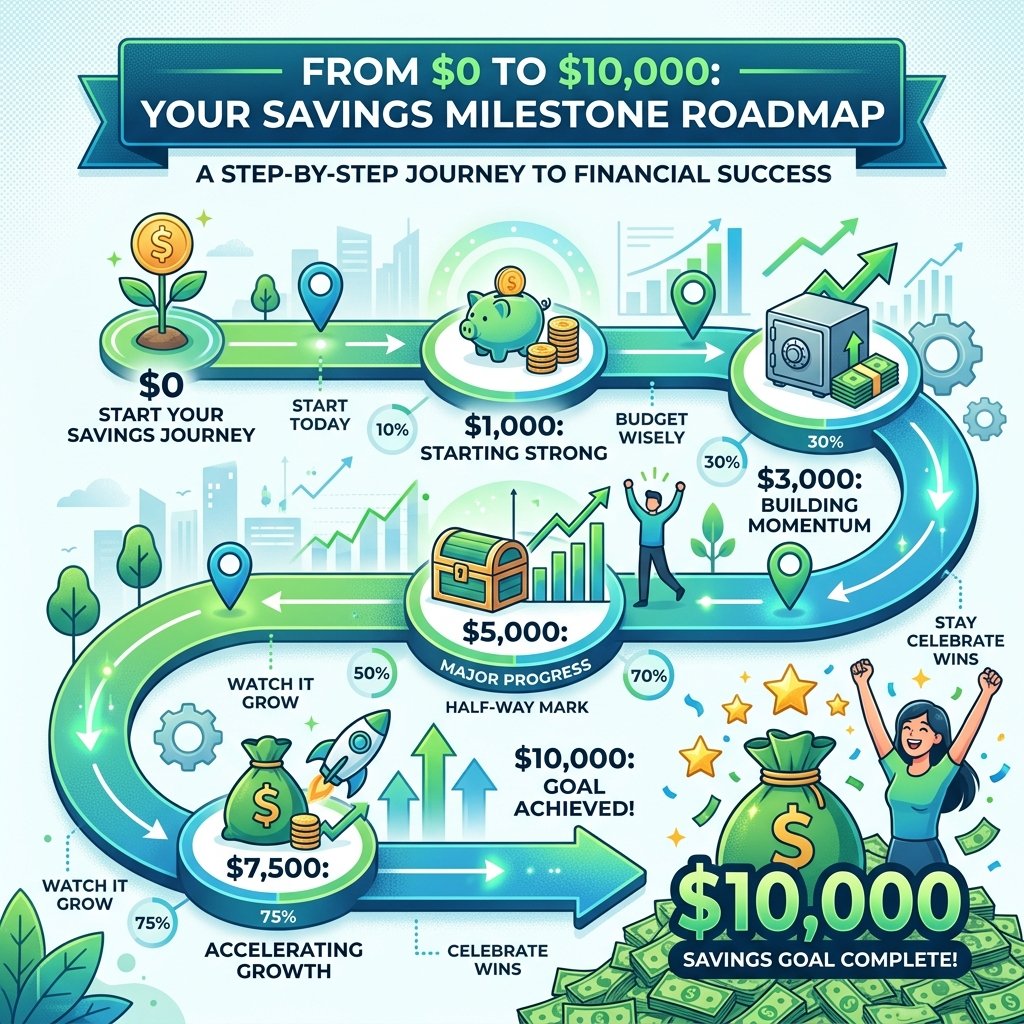
Let’s break down five realistic scenarios based on monthly savings:
| Monthly Savings | Time to $10,000 | Strategy |
|---|---|---|
| $200/month | 46 months (~4 years) | Cuts only, no side income |
| $350/month | 27 months (~2.3 years) | Moderate cuts + small side gig |
| $500/month | 19 months (~1.6 years) | Aggressive cuts + regular side income |
| $700/month | 14 months (~1.2 years) | Roommate + side hustle + strict budget |
| $1,000/month | 10 months | All strategies combined |
Even the slowest path gets you there. The point is not speed — the point is starting.
What $10,000 Actually Does for You
Your first $10,000 is not just money in a bank account. It is a psychological checkpoint that changes everything:
- Peace of mind: A car repair, medical bill, or sudden job loss no longer destroys you.
- Mental bandwidth: You stop worrying about survival and start thinking about growth.
- Negotiating power: $10,000 gives you the ability to say no — to bad jobs, bad deals, and bad situations.
- Momentum: The habits that built $10,000 will build $50,000, $100,000, and beyond.
The moment you stop worrying about day-to-day survival is the moment you start building a real life.
The Bottom Line
Say it out loud: you do not need to earn more money to start building wealth. You need a system that works on your current income.
Here is your system in six lines:
- Know your numbers — track every dollar for 30 days
- Cut the Big Three — housing, food, and transportation
- Automate savings — pay yourself first, every payday
- Earn a little extra — 100% of side income goes to savings
- Protect your progress — no new debt, no lifestyle creep
- Stay patient — the math always works
You do not need to earn six figures to build wealth. You need to start where you are with what you have. Your first $10,000 is waiting. Go get it.
Frequently Asked Questions
Q: What if I literally have zero dollars left after bills?
A: Start with your Big Three expenses. Almost everyone can reduce housing, food, or transportation by at least $100/month. If you truly cannot, focus entirely on earning extra income first.
Q: Should I pay off debt or save first?
A: Build a $1,000 emergency buffer first, then attack high-interest debt (above 10% APR). For lower-interest debt, save and pay simultaneously — split extra money 50/50.
Q: What should I do after I hit $10,000?
A: Keep going. Build a 6-month emergency fund (6 × your monthly expenses). Then invest in skills that increase your income, or start putting money into low-cost index funds.